
Fabrication Begins on Lancet™ XL-UUV for DIU’s CAMP Program
- Date:
- September 14, 2026
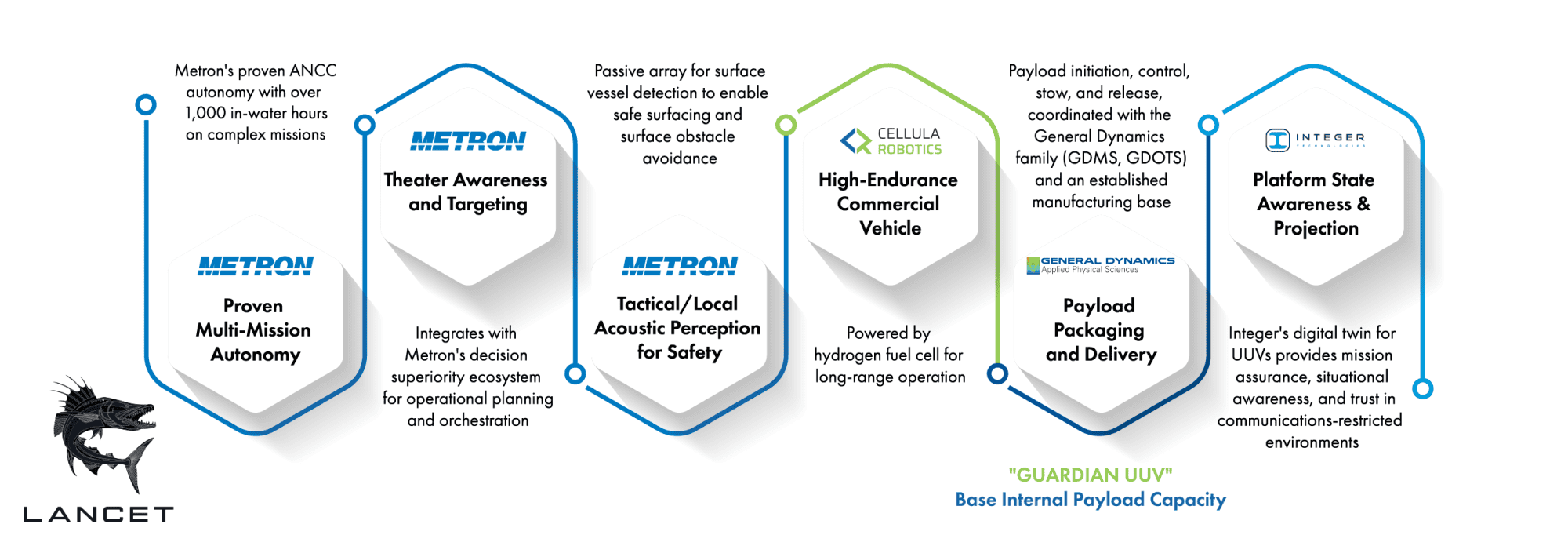
RESTON, Va. — The CAMP team, led by Metron, has begun fabrication of Lancet™, the integrated XL-class uncrewed undersea vehicle (UUV) being developed for the Defense Innovation Unit’s (DIU) Combat Autonomous Maritime Platform (CAMP) program. Cellula Robotics and its fabrication partners have begun work on the nose, tail, and extended midsection of the MOXSEA XL-UUV, derived from Cellula’s COTS Guardian AUV®. In parallel, General Dynamics Applied Physical Sciences (GDAPS) has continued fabrication efforts and will complete the payload deployment module assembly in late September.
CAMP addresses a clear operational need: autonomous undersea systems capable of deploying large payloads across extended ranges in contested, communications-denied environments. The program calls for a vehicle that can transit at least 1,000 nautical miles, operate autonomously at depths beyond 200 meters, and work through open interfaces with government and third-party command-and-control software. The CAMP demonstration is scheduled for March 2027.
“The start of fabrication is an important program milestone and reflects progress across the full CAMP team,” said Van Gurley, President and CEO of Metron. “The program has now moved from detailed design into fabrication and integration. Lancet brings together proven technologies from a strong team, and we are on track to integrate them into a system built to meet the Navy’s operational and technical needs.”
Metron leads the CAMP team as prime contractor and provides the mission-proven ANCC autonomy software, shoreside command and control (C2), systems integration, and program leadership. Cellula Robotics provides the MOXSEA platform, the payload module, integration of the NautiGEN hydrogen fuel cell energy system, and vehicle engineering. MOXSEA builds on the Guardian AUV® platform and the common architecture used across Cellula’s UUV portfolio, including Envoy AUV®. Integer Technologies contributes dynamic vehicle modeling and vehicle health monitoring. GDAPS develops the payload control and deployment capabilities. Together, the team is integrating these technologies into Lancet, a configurable system that combines the undersea vehicle with shoreside command and control for extended-range payload delivery, mission adaptation at depth, and future integration with U.S. Navy systems.
“MOXSEA draws on major components and architecture from Guardian, scaled to meet the customer’s requirements,” said Neil Manning, Chief Executive Officer of Cellula Robotics. “In order to rapidly produce multiple vehicles, Cellula has set up separate US and Canadian manufacturing programs to ensure customer delivery across US and Allied Nations programs. Integrated with COTS NautiGEN Hydrogen Fuel Cells technology, Lancet will provide long-duration, extended reach capabilities we believe unmatched in the size and form factor of Lancet. The configurable multi-payload architecture also allows the end user to repurpose the system with interchangeable payloads.”
Media Contacts
Shelby Condray, Manager, Corporate Communications, Metron, Inc., Metron-Info@metsci.com
Kira Coley, Head of Marketing and Communications, Cellula Robotics, Kcoley@cellula.com
About Metron
Metron is an advanced technology company with more than 40 years of proven performance in national security. Founded in 1984 with roots in applied mathematics and statistics, Metron turns rigorous first-principles scientific problem solving into operational capability, from early concept through rapidly deployed programs of record in the most complex operational environments.
The company’s culture and success are built on world-class technical expertise, deep domain knowledge, cross-disciplinary teams, and an unwavering mission focus. This formula consistently delivers solutions that end users can trust in complex, ambiguous, and demanding situations.
Metron is headquartered in Reston, Virginia, with offices in Portland, Oregon, and on-site support locations across the country. metsci.com
About Cellula Robotics Ltd.
Cellula Robotics Ltd. is a privately owned Canadian marine technology company that designs and manufactures long-endurance autonomous underwater vehicles and integrated subsea systems.
Headquartered in Burnaby, British Columbia, with operations in Canada, the United States and the United Kingdom, Cellula supports defense, security, survey, science and environmental customers operating in complex maritime environments.
Cellula combines hydrogen fuel-cell power, configurable payloads, vehicle control and systems integration to support extended-range missions, persistent subsea awareness, critical infrastructure protection, geophysical survey and scientific research. www.cellula.com
About Integer Technologies
Integer is an agile defense technology company that transforms raw data into decision advantage, protecting our country and ensuring a safer world. We partner with the brightest minds in industry and academia to create mission-focused solutions that refine complex information into actionable intelligence, empowering humans and autonomous systems to predict the probabilities in uncertain environments. Our digital engineering portfolio spans robotic and unmanned systems, sensors and perception, power and energy systems, advanced manufacturing, and cyber‑physical systems. www.integer-tech.com
About General Dynamics Applied Physical Sciences
Applied Physical Sciences Corporation (APS) is a rapidly expanding research and development firm specializing in innovative products and cutting-edge technology solutions for rising commercial and national security market challenges. Our solid foundation in advanced mathematics and fundamental physics forms the basis of our problem-solving methodology. We develop our technical solutions in accordance with solid engineering practices and in science to address the most pressing requirements of our clients. Our capabilities include maritime sensing systems, signal and information processing, ocean engineering and hydrodynamics, undersea communications, underwater signatures and platform noise, structural mechanics, and more. www.aphysci.com