
Wednesday, January 7
Question 1
Sleeping Beauty volunteers to undergo the following experiment and is told all of the following details: On Sunday she will be put to sleep. Once or twice, during the experiment, Sleeping Beauty will be awakened, interviewed, and put back to sleep with an amnesia-inducing drug that makes her forget that awakening. A fair coin will be tossed to determine which experimental procedure to undertake:
— If the coin comes up heads, Sleeping Beauty will be awakened and interviewed on Monday only.
— If the coin comes up tails, she will be awakened and interviewed on Monday and Tuesday.
In either case, she will be awakened on Wednesday without interview and the experiment ends.
Any time Sleeping Beauty is awakened and interviewed she will not be able to tell which day it is or whether she has been awakened before. During the interview Sleeping Beauty is asked: “What is your credence now for the proposition that the coin landed heads?”
- How should she answer?
Question 2
Consider an equilateral triangle inscribed in a circle.
- What is the probability that a randomly chosen chord of the circle is longer than a side of the triangle?
Question 3
A pack of N cards is initially partitioned into m piles. A card is removed from each pile. These are used to form a new pile with m cards, whereas any piles that had only 1 card are now gone. This process is repeated indefinitely.
- Prove that if N = k (k + 1) / 2, then, regardless of the initial partition, the sizes of the piles will eventually reach a fixed point in which the pile sizes are 1, 2, 3, …, k.
Tuesday, January 6
Question 1
- Prove that among any n + 1 distinct positive integers chosen from {1, 2, 3, …, 2n}, two can be chosen such that one divides the other.?
Question 2
- Prove that the positive integers cannot be partitioned into a finite number (greater than 1) of arithmetic sequences that all have different strides.
Question 3
In Hilbert’s prison, the inmates are labeled by a bijection with the positive integers. In the morning, they will line up in order and each be assigned a red or a blue hat. Each will face right, seeing all hats of higher-numbered prisoners but no others. Starting with prisoner 1, each prisoner will guess the color of their own hat. Guessing wrong kills the prisoner.
The prisoners can meet beforehand to strategize. They are allowed to invoke the axiom of choice in formulating their strategy.
- How can they ensure that only a finite number of them die, even if they cannot hear the other prisoners’ responses?
- How can they ensure that at most one dies if they can hear the others’ responses.
Monday, January 5
Question 1
In London, many of the Underground stations have three escalators. It’s always the case that two of them are up escalators, and one is a down escalator. It doesn’t matter which way the rush hour crowds are moving, or if more people are arriving or leaving, or the time of day: there are always two that go up, and one that goes down.
But when the station with the escalators is elevated above ground, the opposite situation holds. That is, there are two escalators going down, and one going up.
- Why is this?
Question 2
Reg and Randy take buses that arrive every 10 minutes, on average.
Reg’s buses arrive regularly: one every 10 minutes.
Randy’s buses arrive randomly: the wait times are exponentially distributed.
- If Reg and Randy arrive at their bus stops at (uniformly distributed) random times, how long does each wait, on average?
Question 3
A certain ice cream shop has seating for exactly three people on three closely spaced stools at the front window. Because of this, customers are very predictable in how they choose their seat. If either of the left or right stool is open, then they will sit there. If both are open, they will choose randomly between left and right. They will sit at the middle stool if and only if both the left and right stools are occupied but the middle stool is free. If all three stools are occupied, they will simply leave the shop and eat their ice cream elsewhere.
Customers arrive at the stools via a Poisson process at a mean rate of one customer every 6 minutes. Each customer spends exactly 12 minutes seated eating their ice cream before leaving.
- Assuming that the ice cream shop has been in continuous operation for a very long time, what is the probability that, at any given moment in time, the middle stool is occupied?
Sunday, January 4
Question 1
A chocolate bar consists of 25 small squares arranged as a 5×5 grid. Your task is to snap the bar (along the lines between squares) into smaller pieces and to keep snapping the pieces you make until you arrive at the 25 individual squares. You may not stack multiple pieces to snap them at the same time.
- Prove that it takes the same number of snaps to complete your task, regardless of how you go about it.
Question 2
There is an 8 × 8 grid of lightbulbs. A lightbulb turns on if at least two of its orthogonal neighbors are on.
- What is the minimum number of lightbulbs that must be on initially for the whole grid to eventually light up?
- Prove that this number is, in fact, minimal.
Question 3
Peg solitaire is a game played on a slotted board with pegs arranged in various patterns. In the English formulation of the game, the board starts like this:
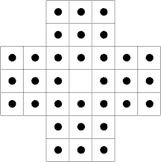
Each black dot represents a peg, which may jump over an adjacent peg (i.e., one sharing an edge) provided it has an empty hole to land in. Such a jump removes the neighbor that was jumped over.
The goal is to invert the initial pattern, leaving only a single peg in the center. In 1912, Ernest Bergholt found an 18-move solution (proven optimal by John Beasley in 1964) counting multiple jumps by the same peg as a single move.
- Can you invert the grid?
- In how many moves?
- How does the problem change if you count each individual jump as a move?
Complete the form below to start a conversation with our recruiting team.
"*" indicates required fields
Metron builds its Research Scientist team deliberately and selectively, hiring to specific program needs rather than through large, continuous intakes. We currently have a Research Scientist opening posted and encourage qualified candidates to apply via our careers page.
If the timing or specific role isn’t the right fit, we still welcome you to use the form above to start a conversation with our recruiting team. We regularly revisit strong candidates as new needs arise, and JMM is one of the key places where those relationships begin.

Team Members
What was the transition like from academia to working in industry? What did you or what would you have done to prepare?
Shifting from academic work in graduate school to industry work felt natural to me because I was able to directly use the skills in my applied math toolbox. Over my time with Metron, I have added to that toolbox more probability and statistics, and if I could do anything differently to prepare for the job it would be to take courses in those fields in college.
Were you initially looking for a role in academia or industry?
Initially I thought I wanted to be a professor, but over time I found that I was more drawn to problems that were already important to people and needed solutions.
What attracted you to a position at Metron?
I liked that Metron was a place where I would be working with many other mathematicians on real-world problems that were important, challenging, and interesting. Metron wanted PhD’s in mathematical fields and didn’t care if you had worked for a long time in a specific domain or not, but rather that you were sharp; good coding skills were a plus. Those requirements, despite being very short and general, aligned well with my experience. The lack of detail turned out to be a good thing because I wasn’t pigeon-holed into a specific type of work but rather was introduced to a variety of new problems and trusted with finding the solutions.
How did your academic and/or professional background lead you to working at Metron?
Early in grad school, a Metronite who was an alumnus from my university gave a talk at our applied math department, and I thought that the work sounded really cool. During my last year of grad school, I saw a position at Metron pop up in an applied math job board, I remembered that talk, and I applied.
What was the transition like from academia to working in industry? What did you or what would you have done to prepare?
Being more proficient at coding and having more experience with project management software would have been useful in making the transition from academia to this job. Coming from a pure math field and doing research primarily solo or with one collaborator (my advisor) meant that I did not come across these things naturally in my time as a graduate student.
Were you initially looking for a role in academia or industry?
I was almost exclusively looking for teaching positions.
What attracted you to a position at Metron?
It seemed like a change of pace from what I had been looking for
- Metron reached out to me first (this was probably the biggest factor)
- There was a specific project Metron had at the time (Cascade) that was looking to leverage my research area. I didn’t end up working on that project, but the fact that people at the company were doing that kind of work increased my interest in Metron.
How did your academic and/or professional background lead you to working at Metron?
Early in grad school, a Metronite who was an alumnus from my university gave a talk at our applied math department, and I thought that the work sounded really cool. During my last year of grad school, I saw a position at Metron pop up in an applied math job board, I remembered that talk, and I applied.
What was the transition like from academia to working in industry? What did you or what would you have done to prepare?
My prior active-duty military experience significantly smoothed the transition from academia to industry. Throughout my academic journey, I deliberately focused on developing skills that would be valuable in both academic and industry settings.
Were you initially looking for a role in academia or industry?
I approached my career search with equal interest in both academic and industry opportunities.
What attracted you to a position at Metron?
Meeting with Metron at JMM and learning about their real-world applications of advanced mathematics was genuinely compelling. Their work offered an ideal opportunity to pursue innovative research while creating meaningful real-world impact.
How did your academic and/or professional background lead you to working at Metron?
The combination of my military background and rigorous mathematical training through my PhD created a unique skill set that aligned perfectly with Metron’s needs. My experience bridging theoretical mathematics with practical applications made Metron feel like a natural fit.
What was the transition like from academia to working in industry? What did you or what would you have done to prepare?
My transition was challenging and interesting. My focus changed from working primarily on my own to produce publication-worthy pure math research to working in project teams to develop solutions for complex customer problems. I learned new (to me) programming languages and skills to collaborate to produce integrated software technologies, demos, reports, and presentations.
Were you initially looking for a role in academia or industry?
I was looking almost exclusively at jobs in academia as a professor of mathematics.
What attracted you to a position at Metron?
After speaking with Metron at the Joint Math Meetings, then having an on-site interview, I turned down a tenure-track professorship offer to become a research scientist at Metron. I was intrigued by the prospect of collaborating with brilliant mathematicians, computer scientists, physicists, and other experts to solve real-world problems and provide impactful capabilities to customers who need them.
How did your academic and/or professional background lead you to working at Metron?
In my academic training – from undergraduate research through my math Ph.D. program and one year as a visiting professor – I developed skills to grasp difficult concepts, I explored a broad spectrum of research areas in math and computer science, and I honed my ability to solve complex problems. All of these skills prepared me well to collaborate with experts at Metron and develop principled, effective solutions to real problems.